Heating
Heating Repair
A furnace that short cycles, locks out or runs without heating the house is usually one failed part, not a dead system. We find the part and show you the reading that proves it.
The shutdown that looks like a dead furnace
Most heating calls in Conroe arrive with the first real cold snap, after months of the furnace sitting idle in an attic or a garage closet. The thermostat calls for heat, the inducer fan spins up, the igniter glows, and a few seconds later everything shuts down and the house stays cold. Homeowners assume the furnace has died. More often a flame sensor coated in a thin film of carbon can no longer prove the flame is lit, so the control board closes the gas valve as a safety measure.
Other failures hide behind the same symptom. An igniter that never reaches temperature, a pressure switch that will not let the sequence start, or a filter so loaded that airflow collapses and the limit switch trips on overheat will all leave you with burners that fire, quit and fire again. From the thermostat, short cycling looks like one problem. In the cabinet it is four or five different ones, and they cost very different amounts to fix, which is why guessing and swapping parts is the expensive way to heat a house.
Heat pumps fail differently, and some homes here heat with one. In winter the outdoor coil can frost over, and the defrost cycle is supposed to melt it by briefly running the system in reverse. When a defrost sensor or control board fails, the coil turns into a block of ice, the airflow drops and the vents blow lukewarm air. A heat pump that looks frozen is a diagnosis waiting to be made, not a unit to replace, and our technicians check both furnaces and heat pumps, all makes and models.
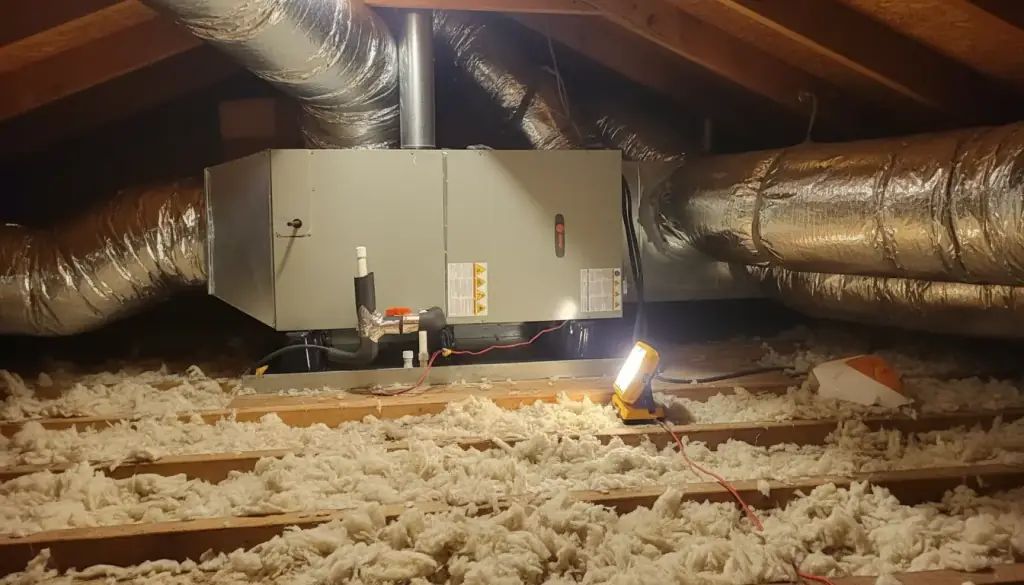
Gas furnace on an attic platform with insulated flex duct and the flue rising through the roof deck
The order we test things in, and what gets written down
The visit starts with the history, not the toolbox: what the furnace did, when, and what code the control board is flashing. Then the technician watches a full sequence of operation from the call for heat through to blower cutoff, with a light and a meter at the cabinet, whether the furnace sits on an attic platform or in a closet. Watching it fail on purpose beats reasoning about it from the thermostat, because the point where the sequence stops names the part that let go.
Then come the readings. Gas pressure is checked at the manifold. The temperature rise across the furnace, the supply air minus the return air, is compared with the range printed on the nameplate. Blower motor amp draw is measured against its rating, and the flame sensor signal is read before and after it is cleaned. If the heat exchanger is in question, it gets looked at directly rather than assumed either way, because a cracked exchanger is a safety matter and a clean one should not be condemned on a hunch.
You are told in plain words what failed, why it failed and what it costs to fix before anything is replaced. If the honest answer is that the unit is at the end of its service life, we say that too, and a free estimate on a replacement can follow the same visit. If you already hold an install quote from someone else, we offer a same-day second opinion, subject to scheduling availability and location. Our NATE-certified technicians work under Texas contractor licence TACLA 20944C and the work carries a written guarantee.
How to tell it will fail again, and what skipping costs
A repair that holds has a reason. If the same shutdown returns within a week, the first fix was a symptom: a flame sensor that gets dirty again quickly points at the burner or a weak ground rather than at dirt, and a limit switch that keeps tripping points at airflow, a return that is too small or a blower that is tired. A furnace that runs a long time and delivers weak heat is usually asking for a filter, a duct repair or a blower check, not a new furnace.
Skipped repairs get more expensive in a specific order. A furnace left short cycling wears out its igniter, its inducer and its control board far faster than one that runs in long, steady cycles. A heat pump left iced up works its compressor against a block of frost. And a cracked heat exchanger is a safety problem, not a comfort problem, so the right move there is to shut the furnace off and have it looked at before the next cold night, whatever the weather forecast says.
The cheapest repair is the one caught in the fall. Our maintenance agreement starts at $16.58 a month and includes two visits a year with reminder service, a 21-point inspection, priority status and no overtime fee, so the flame sensor and the filter are checked before the cold arrives rather than on the coldest morning. We answer 7 days a week from 7:30am to 8pm in Conroe, The Woodlands, Magnolia, Montgomery, Spring and Willis, with on-call cover outside those hours.
Licensed, bonded and insured. TACLA 20944C. Call (936) 703-2130.
The sequence we watch
Where each reading comes from
A gas furnace has to finish a fixed run of events every time it heats. The step where it stops, and the number we read there, is the diagnosis. Every reading goes on your work order, which is why a second look from us is same-day.
If the furnace turns out to be past repair, heating replacement starts with a free estimate.
Call for heat
The thermostat closes its circuit and we confirm the signal actually reaches the control board.
Inducer starts
The draft motor clears the flue before anything lights, so we listen to it and read its amp draw.
Pressure switch proves draft
It closes only when real airflow exists. A switch that will not close stops the sequence right here.
Igniter glows
We watch it reach temperature, since a weak igniter is the quiet cause of many no-heat calls.
Gas valve opens
Manifold gas pressure is measured and written down.
Flame is proven
The flame sensor signal is read before and after cleaning. A carbon film here is behind most lockouts.
Blower starts
Supply air minus return air gives the temperature rise, compared with the range on the nameplate.
Heat is satisfied
The valve closes and the blower runs on to clear the cabinet, so we confirm both happen cleanly.