Cooling
Air Conditioning Repair
Warm air at the vents, a system that will not stop running, or a bill that jumped for no reason you can see. We find the actual cause, and write the numbers down, before we quote anything.
Why a Conroe AC runs all afternoon and still cools like it has given up
In Montgomery County the first sign is rarely a dead system. It is a system that runs and runs, with air at the vents that feels lukewarm, a thermostat that will not reach its setting by late afternoon, and a power bill that climbed without any change in how you live. From inside the house a weak capacitor, a low refrigerant charge, a coil packed with leaves and dust, and a blown low-amp fuse all feel exactly the same, which is why guessing at the cause costs people money.
The failures we see most share a pattern. A capacitor goes weak before it goes dead, so the compressor strains for weeks. A control fuse blows and gets replaced by someone who never asks why it blew, so it blows again. A slow leak lets the charge drift down until the evaporator coil ices over. A condenser coil clogs until the system cannot shed heat. Each one has a different repair, and only one of them is the expensive one.
A Google reviewer, Whocares33, described a 3-ton unit that started with only about a 10-degree temperature split and was struggling to cool properly. That is the call we take from Conroe, The Woodlands, Magnolia, Montgomery, Spring and Willis all summer: the house is warm, the unit is running, and nobody can say why. The answer is almost always sitting in a reading that nobody has taken yet.
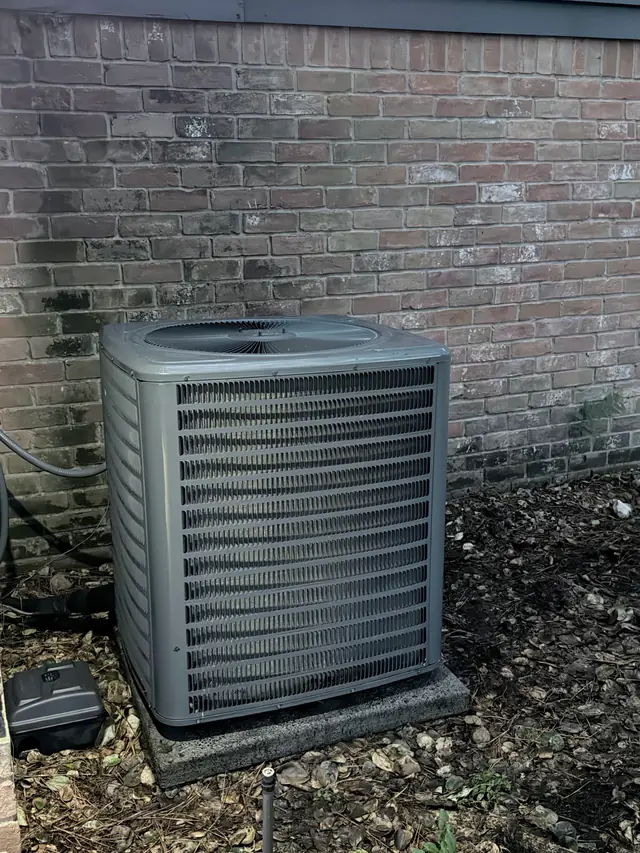
Outdoor condenser on its pad against a brick wall in Montgomery County
Three readings before a single part comes off the truck
Our NATE-certified technicians start by running the system through a full cooling cycle, then writing down the return air and supply air temperatures and subtracting one from the other. That is the temperature split. A healthy split sits somewhere in the mid teens to low twenties, and a low one says the system is running without actually moving heat. It points straight at airflow or refrigerant charge, so the next step is already decided by the number.
Next comes the amp draw. We clamp the compressor and the condenser fan motor and compare what they pull against the nameplate rating printed on the unit, because a motor drawing high is a motor in trouble and a motor drawing low is often a system starved of refrigerant. Then we take static pressure across the coil and blower, which tells us whether your ducts and filter are choking the air handler before the compressor ever gets blamed.
If the readings point to a low charge we do not top it off and leave. We find the fuse or capacitor that failed, run a leak test, and add refrigerant only once the test says the system is tight or the leak is known. Whocares33 wrote about that exact sequence: a blown 5-amp fuse replaced, a thorough leak test, and the refrigerant the system needed added. We repair all makes and models, not only Comfortmaker.
What a repeat call tells you, and how to stop one
After the repair we take the same readings again and set them beside the first set, so you can see what changed. In that same review the split improved to about 25 degrees after service, and the unit was cooling better than it had in a long time. A repair is finished when the numbers move, not when the truck leaves the driveway, and every job we do carries a written guarantee.
If a repair skipped the cause, the symptom comes back. A fuse that blows twice means something downstream is drawing too much. A coil that ices again means airflow or charge was never actually fixed. A bill that creeps up through July with no change in how you use the house usually means a part is quietly failing, and a small fix this week can avoid a compressor replacement in August. Call (936) 703-2130 and tell us what you are seeing.
We answer seven days a week from 7:30am to 8pm, with on-call cover outside those hours, across Montgomery County. If the same fix keeps returning, or the system is old enough that another repair no longer makes sense, we say so plainly and walk through what a replacement involves, with a free, no-obligation estimate and a same-day second opinion on any install quote you already hold. Licence TACLA 20944C is painted on our service van door.
Licensed, bonded and insured. TACLA 20944C. Call (936) 703-2130.
The page the technician fills in
Five readings, each with a line to write the number on
Every visit ends with figures the technician wrote down, which is why a second opinion here is same-day and costs nothing. Your numbers go on these lines.
Return and supply air temperature
The split. Low means the system is running without moving heat.
Compressor and fan amp draw
Measured against the nameplate. High means strain, low often means starved of charge.
Static pressure at coil and blower
Whether ducts and filter are choking the air handler.
Refrigerant charge after a leak test
Whether the charge drifted, and whether anything is leaking.
Condensate drain flow
Whether water leaves the house or backs up into the pan.
From a Google review by Whocares33: split about 10 degrees before service, about 25 degrees after.
If the readings say the equipment has reached the end of its repairable life, the next step is a free estimate on a replacement system. If they say it is healthy but ageing, our twice-a-year maintenance keeps the numbers on file.